U.S. Artificial Intelligence Market Analysis
Comprehensive PESTEL and SWOT analysis of the AI market landscape in 2024-2026
Market Size (2025)
$220B
Growing at 30.6% CAGR
US Investment
$109.1B
12x China's investment
Regulations (2024)
59
2x increase from 2023
Projection (2035)
$976B
5.4x growth by 2035
Market Growth Trajectory
Projected AI market size from 2024 to 2035
- Market Size
Global Investment Distribution
The United States dominates global AI investment, attracting more capital than all other major economies combined. This leadership reflects the strength of the U.S. tech ecosystem, venture capital infrastructure, and established AI research institutions.
PESTEL Analysis
Macro-environmental factors shaping the U.S. AI market
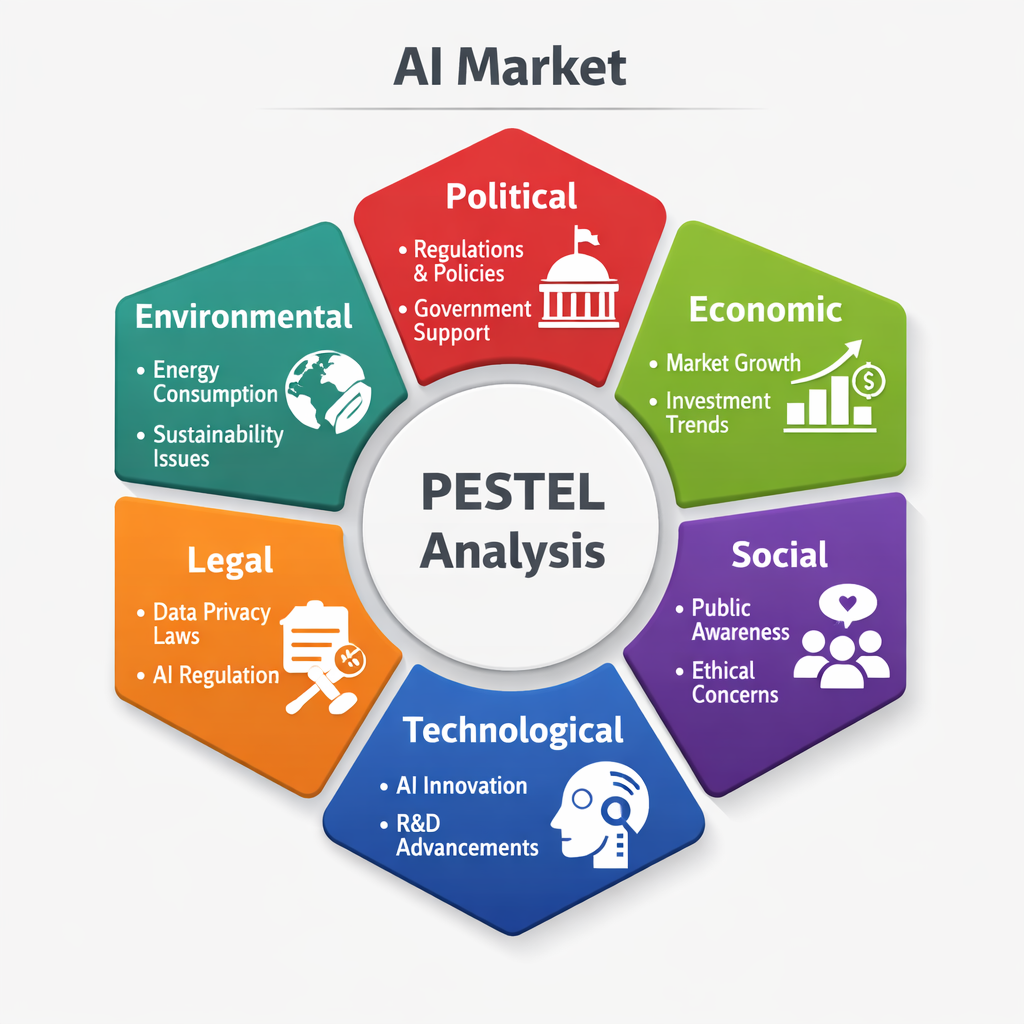
Political
The U.S. federal government introduced 59 AI-related regulations in 2024, doubling from 2023. Federal R&D funding remains steady at $3.3 billion, while political discourse focuses on maintaining technological sovereignty.
- Regulatory framework development
- Government support initiatives
Economic
AI dominates U.S. equity markets with IT sector growth of 23.6%. Private investment reached $109.1 billion, yet high capital expenditures and talent shortages present ongoing challenges.
- Record private investment
- Market growth at 30.6% CAGR
Social
Public sentiment increasingly demands Responsible AI. Gen Z priorities shape workplace expectations, while educational institutions integrate AI into curricula to meet future labor demands.
- Ethical AI awareness
- Educational integration
Technological
The U.S. leads in technical breakthroughs including multimodal models and autonomous agents. NVIDIA's GPU dominance drives performance but creates supply chain dependencies.
- Rapid innovation pace
- Hardware leadership
Legal
The legal landscape evolves to address copyright, data privacy, and liability. Legislative mentions of AI increased ninefold since 2016, creating both challenges and opportunities.
- IP protection frameworks
- Privacy regulations
Environmental
AI's massive energy consumption drives pressure for sustainable practices. Companies increasingly invest in green energy solutions to offset data center carbon footprints.
- Sustainability focus
- Green energy adoption
SWOT Analysis
Strategic assessment of the U.S. AI industry
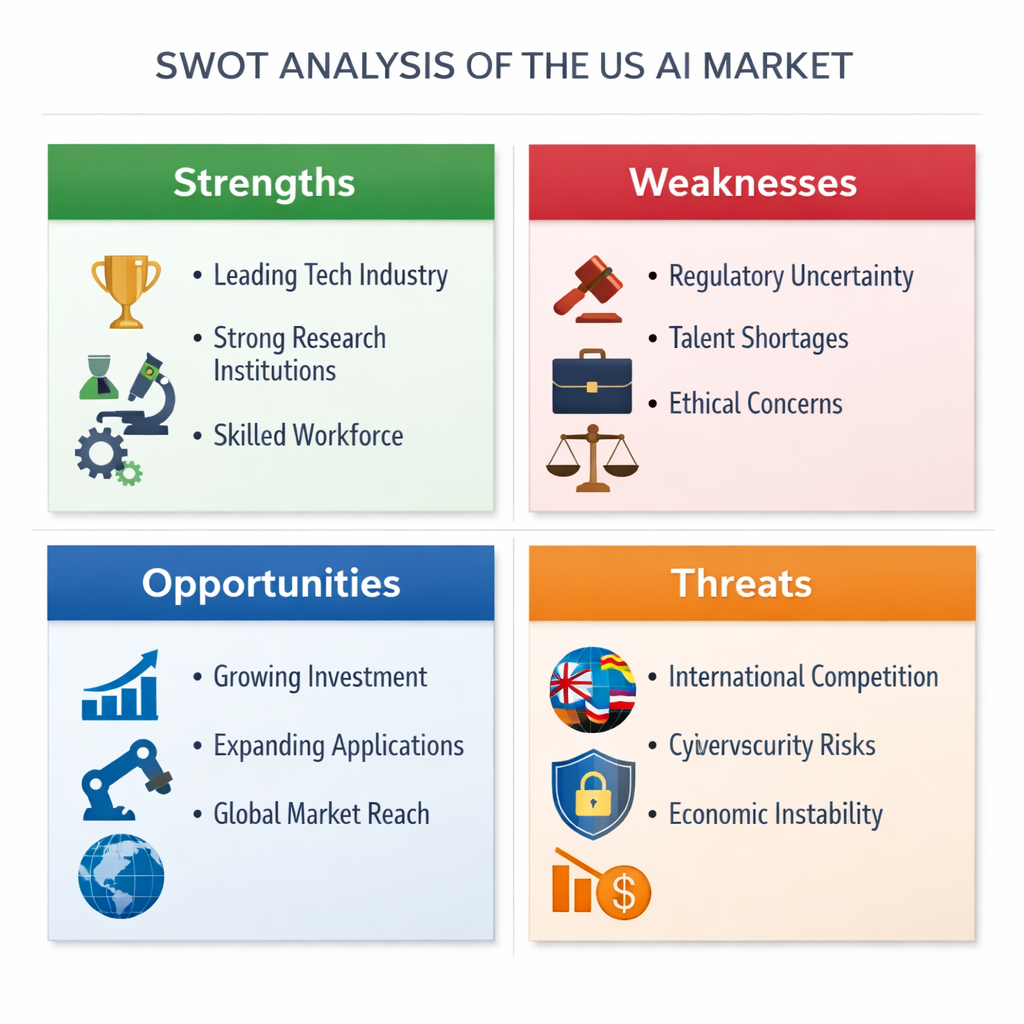
Strengths
- •
Capital Dominance
Attracts lion's share of global private investment with record-breaking funding rounds
- •
Innovation Ecosystem
World-class research institutions and mature venture capital landscape
- •
Market Giants
Big Tech companies provide infrastructure and distribution for scaling
Weaknesses
- •
Infrastructure Costs
Astronomical training costs create barriers to entry for smaller players
- •
Talent Gap
Persistent shortage of specialized AI researchers and engineers
- •
Hardware Dependency
Heavy reliance on limited number of high-end compute providers
Opportunities
- •
Sector-Specific AI
Immense potential in healthcare, government, and enterprise modernization
- •
Edge Computing
Shift to local model execution opens new markets for hardware and software
- •
Global Leadership
Opportunity to lead development of international AI safety standards
Threats
- •
Regulatory Overreach
Excessive regulation could stifle innovation and drive talent abroad
- •
Cybersecurity Risks
AI-powered threats including deepfakes pose national security risks
- •
Global Competition
Aggressive investment from other nations threatens U.S. technological leadership
AI Adoption by Sector
Current adoption rates across major industries (2025)
Healthcare Leadership
Health systems lead with 27% adoption, followed by outpatient providers at 18%, positioning healthcare as the AI adoption frontrunner.
Enterprise Acceleration
Departmental AI spending hit $7.3B in 2025, growing 4.1x year-over-year, with coding as the primary use case.
Revenue Impact
71% of marketing and sales respondents report revenue growth from AI use, demonstrating clear ROI across business functions.
Key Takeaways
Market Dominance: The U.S. AI market is valued at approximately $220 billion in 2025, with projections reaching nearly $1 trillion by 2035, maintaining global leadership through unprecedented private investment and innovation.
Regulatory Evolution: The regulatory landscape is rapidly evolving, with 59 new AI-related regulations introduced in 2024. Companies must navigate this complex environment while maintaining competitive advantage.
Sector Opportunities: Healthcare, finance, and enterprise software lead AI adoption, with healthcare systems showing 27% adoption rates and significant potential for further expansion.
Strategic Imperative: Organizations must balance innovation with responsible AI practices, address talent shortages, and leverage the U.S. ecosystem's strengths while mitigating emerging threats from global competition and regulatory uncertainty.